This family record is still being assembled — letters, photographs, and archival papers are being added. Please enter the access phrase.
That phrase doesn't match. Please try again.
A record in documents · 1925 — 2019
John Robert Murray
First Lieutenant, United States Air Force · later Colonel, Retired
Shot down over North Korea in June 1951, he was telegrammed dead to his family in Brookline — a Silver Star was presented to his parents, a president signed his condolence, a memorial service was held. Then a letter arrived in his own handwriting. He came home in October 1953, after twenty-six months in captivity, to a parade. What his country suspected of him afterward is the part of the story still sitting in the files.
Every entry below is drawn from a named source — the family's own account, the Air Force's award records, or the National Archives' repatriated-prisoner database. Where the record is silent, this page says so.
December 4, 1925
Born in Dorchester, Massachusetts
John Robert Murray — "Bob" — is born to James Phillips Murray, Sr. and Margaret Lappen Murray, a Dorchester family that would later make its home in Brookline.
Source · Obituary, Lee Funeral Homes (2019)
1943 · age seventeen
He volunteers for the war
Too young to wait, Bob enlists in World War II and is accepted as an aviation cadet — a midshipman in the U.S. Navy — then crosses into the Army Air Corps, where he learns to fly all over again in the AT-6 "Texan" trainer.
Source · Obituary (2019)
February 1949
Commissioned into a brand-new Air Force
He graduates a jet pilot of Class 49-A, commissioned a Second Lieutenant just as the United States Air Force becomes its own service. He is, from the first, a jet pilot of the new era.
Source · Obituary (2019)
1950 – 1951
F-80 pilot, 35th Fighter-Bomber Squadron
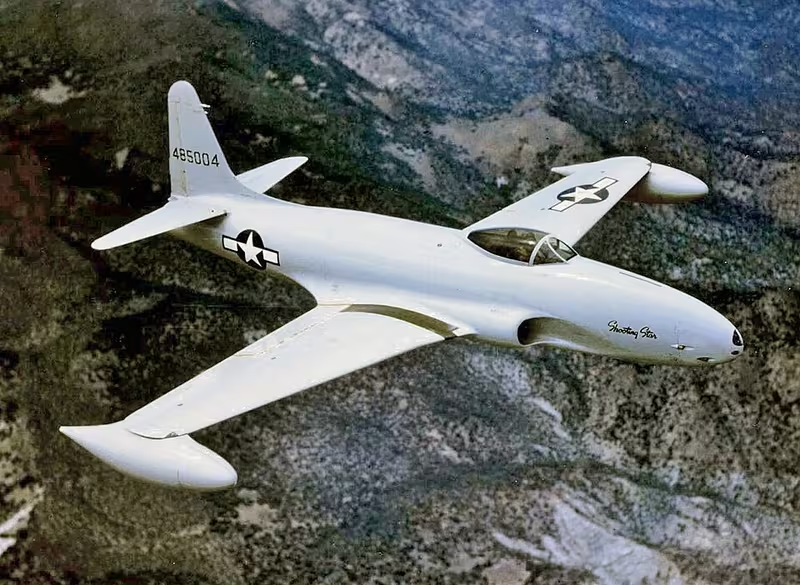
Qualified on fighters and reassigned to the F-80 Shooting Star, Bob flies combat missions over Korea from Itazuke in southern Japan — his first solo jet now a warplane, with the 35th Fighter-Bomber Squadron, 8th Fighter-Bomber Group, Fifth Air Force.
The type he flew — Lockheed P-80 Shooting Star. Photo: Wikimedia CommonsSource · Obituary (2019); Hall of Valor, Military Times
June 28, 1951
Shot down over North Korea
First Lieutenant Murray is shot down on a mission over North Korea and captured by communist forces. He is twenty-five years old. His captivity — in the camps along the Yalu — will last twenty-six months.
Source · NARA, Repatriated Korean Conflict POWs; Hall of Valor (AFSN O-1908577)
December 1951
"Missing in Action" — and worse
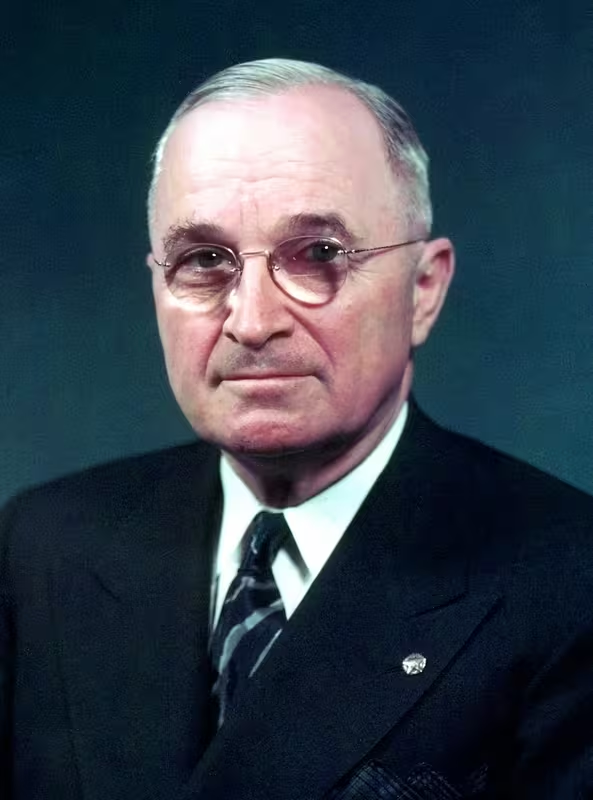
The telegram reaches Brookline: their son is missing. The classification cycles — M.I.A., then Killed in Action, then Missing again. Back home, the military presents his parents the Silver Star posthumously, and a document signed by President Harry S. Truman praises the young lieutenant for dying in service to his country and the United Nations.
The president who signed his death notice. Photo: Wikimedia CommonsSource · Obituary (2019)
1952
A letter in his own handwriting
While the family mourns a memorial service — hundreds of condolence letters, telephone calls, Masses said for him — Bob's mother begins receiving mail written in her son's own hand. Margaret Murray takes the question of her son's very existence to the Office of the Secretary-General of the United Nations in New York. The answer the family gets does not bring him home. The distrust of the institution stays with him for life.
Source · Obituary (2019)
March 19, 1952
The Silver Star — while a prisoner
Unbeknownst to him, Headquarters Far East Air Forces awards him the Silver Star — General Orders No. 134 — "for gallantry in action against the enemy" as an F-80 pilot. The medal is real; the premise of its presentation in Brookline — that its recipient is dead — is about to collapse.
Source · FEAF G.O. No. 134; Hall of Valor; Home of Heroes; NARA award card, Army Air Corps Museum (O-1908577)
September 2, 1953
Operation Big Switch — released
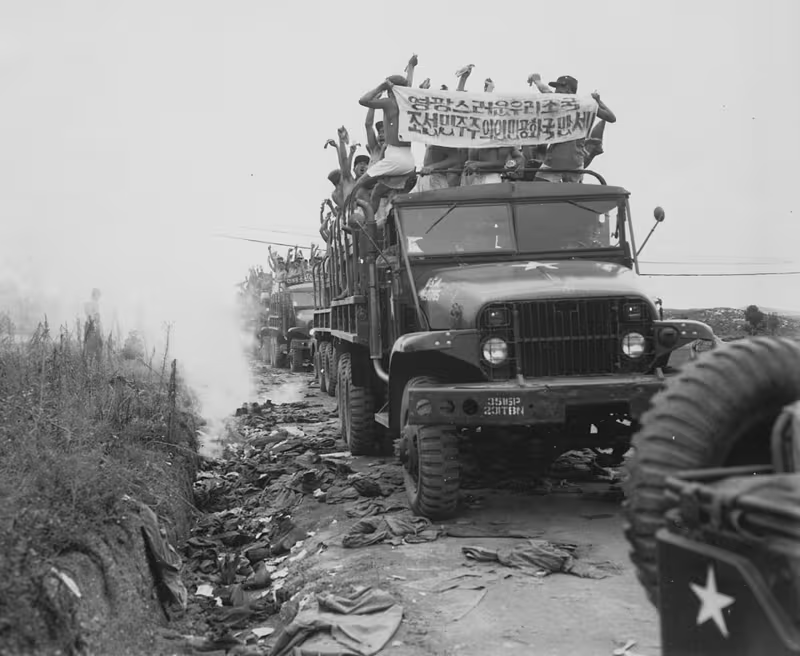
With the armistice, the prisoner exchanges begin. First Lieutenant Murray walks free at Panmunjom after twenty-six months. Aboard the Army ship home there are debriefings and physicals — and, at the processing camp he will only ever call "jail," a bundle of his mother's letters, undelivered until now. He is handed, at last, the proof his family never stopped writing.
The exchange that freed him — Operation Big Switch, Panmunjom. Photo: U.S. National Archives via Wikimedia CommonsSource · NARA, Repatriated Korean Conflict POWs; Hall of Valor; Obituary (2019)
October 4, 1953
The homecoming parade
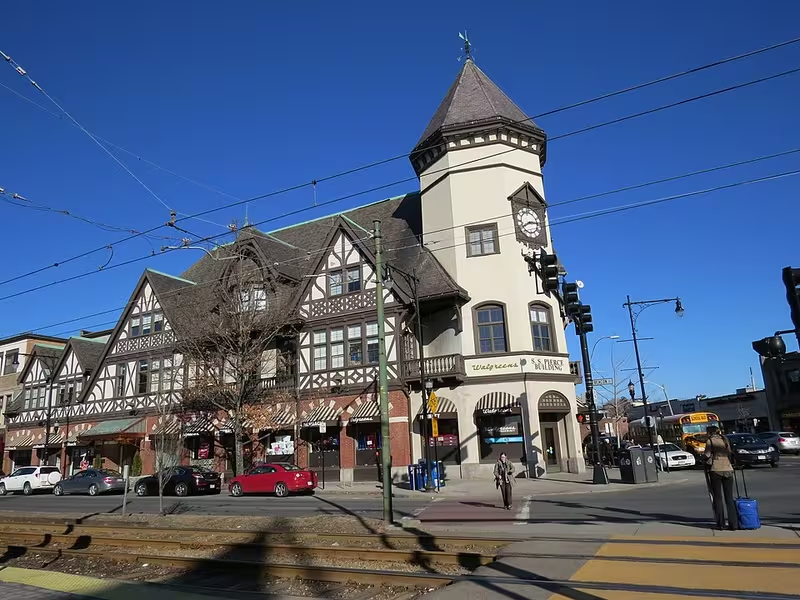
He wires home from Japan; his parents and his sister fly to San Francisco and wave from the dock as the ship comes in. Bob says the greatest high of his life is to be "free again." With his accumulated back pay he buys a new car, and the family drives home across America — the Grand Canyon, Yellowstone, the Donner Pass — to Boston. On Sunday, October 4th, the veterans of his Brookline neighborhood welcome him back with a parade and a program at Brookline High School.
The neighborhood that welcomed him home — Coolidge Corner, Brookline. Photo: Wikimedia CommonsSource · Obituary (2019)
1953 onward
Hanscom — and the long shadow
He asks to serve near his family, and is assigned to a test squadron at Hanscom — the Air Force's research and development complex near Boston. It is good duty, and it is not combat. Behind the homecoming, the Air Force is quietly treating every returned prisoner as a security question (the next chapter of this record). He will serve thirty-five years in all, retiring a full Colonel.
Source · Obituary (2019)
July 9, 2019
Colonel Murray, at rest
Colonel John Robert Murray, USAF (Ret.), dies at ninety-three in Upper Marlboro, Maryland — a thirty-five-year career behind him, and a story his family is still assembling today.
Source · Obituary, Lee Funeral Homes (2019)
The paper trail
The documents
The family holds the paper. When these scans arrive, each folder below becomes a readable facsimile — the telegram, the president's signed document, the letters that crossed the Pacific while he was officially dead.
Document 01 · December 1951
The telegram
The War Department notice that changed Brookline: their son was missing. The paper that began the family's two-year wait.
Scan forthcoming — family archive
Document 02 · 1951 – 1952
The Truman document
The president's signed praise of the lieutenant "who died in service to his country" — addressed to a man then alive in a camp on the Yalu.
Scan forthcoming — family archive
Document 03 · 1952
Letters in his own hand
The correspondence his mother received while he was classified dead — and the letters she wrote back, carried north but undelivered until the ship home handed him the bundle.
Scans forthcoming — family archive
Document 04 · 1952 – 1953
The United Nations correspondence
Margaret Murray's letters to and from the Office of the Secretary-General in New York — a mother asking the world's institution whether her son was alive.
Scans forthcoming — family archive
Document 05 · October 1953
The homecoming
The parade, the program at Brookline High School, the newspapers — a neighborhood's welcome for the man it had already mourned.
Photographs & clippings forthcoming
Document 06 · March 19, 1952
The Silver Star citation
General Orders No. 134, Headquarters Far East Air Forces — gallantry in action, F-80 pilot. Awarded while he was a prisoner of war.
Facsimile forthcoming
Chapter Two
The cloud he came home under
This section is the record's most careful. What follows is what the historical literature documents about every American airman who came back from the camps — and the honest boundary of what is not yet public about John Murray specifically.
What is documented
In 1953–54, the services treated every repatriated prisoner as a potential security risk. An intelligence board's final report held that "every repatriated United States PW must be considered a potential threat" until his captivity was "satisfactorily explained," and estimated some 30% of prisoners had collaborated at some level.
For the Air Force's returned airmen — the very pilots the communists had pressured into "confessions" — 77 of 87 investigated went before Boards of Inquiry; ten were separated or resigned under pressure. The FBI tracked returnees who had signed peace petitions. A secret research program, Project Repair, studied the prisoners for signs of having been turned.
What the family remembers
That Bob came home to a country that never quite trusted him again — suspected, in the family's account, of having been turned by his captors, and kept from flying again — a blacklist felt in assignment after assignment, even as the uniform stayed on.
The record this page can verify shows a thirty-five-year career ending at Colonel. Both things can be true: the suspicion era was real, and men carried its weight in ways the file never wrote down.
Where his file would live
No public document yet names John R. Murray among the accused. His own paper — if it exists — sits in the National Personnel Records Center (St. Louis), the Air Force Historical Research Agency (Maxwell AFB) Board-of-Inquiry and Project Repair holdings, an FBI file obtainable by FOIA, and his RECAP-K debriefing summaries (RG 319, National Archives).
Those requests are the next chapter of this record.
"Bob said the greatest high of his life was to be 'free again.'"
— His obituary, on the day the ship reached San Francisco
The images
Photographs, era and family
Period images below are credited historical photographs. The dashed frames are the family's own photographs and letters — reserved, labeled, and waiting for their scans.
His aircraft type. Lockheed F-80 Shooting Star. Photo: Wikimedia CommonsThe exchange, September 1953. Operation Big Switch, Panmunjom. Photo: U.S. National Archives via Wikimedia CommonsHome. Coolidge Corner, Brookline, Massachusetts. Photo: Wikimedia CommonsThe president's hand. Harry S. Truman. Photo: Wikimedia Commons